Critical Reflection
Community resources like Sovereign Hill offer students an authentic, immersive learning experience that brings history to life in ways textbooks cannot. Place-based education, which emphasizes learning in real-world contexts, is highly effective in fostering deeper engagement with historical concepts (Preston, 2015). Instead of passively reading about the Gold Rush, students at Sovereign Hill can walk through reconstructed goldfields, interact with costumed interpreters, and handle historical artifacts. This sensory-rich experience makes historical events tangible, memorable, and meaningful.
Sovereign Hill is particularly valuable for teaching Year 5 History because it aligns with the Australian Curriculum’s focus on colonial Australia and migration (AC9HS5K02, AC9HS5K04). The site offers opportunities for historical inquiry, allowing students to explore different perspectives—such as those of European miners, Chinese immigrants, and women on the goldfields. By stepping into the shoes of these historical figures, students develop empathy and a more nuanced understanding of the social, economic, and political factors that shaped Australia’s development.
Moreover, experiential learning at Sovereign Hill strengthens historical skills like evaluating evidence, understanding continuity and change, and making connections between past and present (Seixas & Morton, 2013). The museum’s exhibits provide students with opportunities to examine primary sources, such as mining licenses and protest letters from the Eureka Rebellion, helping them engage in critical thinking about governance and justice.
Research highlights that authentic learning experiences significantly improve student engagement, retention, and historical understanding (Falk & Dierking, 2013). Sovereign Hill’s interactive exhibits, demonstrations, and role-playing activities encourage students to think beyond rote memorization and actively engage with historical content.
For example, students investigating the impact of the Gold Rush can participate in a simulated miner’s protest, debating the fairness of mining licenses. This activity helps them understand the origins of Australian democracy while developing critical thinking and communication skills. Similarly, gold panning allows students to experience the challenges of mining firsthand, fostering discussions about economic inequality, resource distribution, and environmental sustainability—all of which remain relevant today.
Museums and historical sites provide multimodal learning opportunities, integrating visual, auditory, and kinaesthetic elements to reinforce understanding (DeWitt & Osborne, 2010). At Sovereign Hill, students can see historical reconstructions, such as 1850s-style shops and homes, to visualize life during the Gold Rush; hear costumed interpreters speak about their roles in society, helping them understand different perspectives; and touch and interact with historical objects, such as mining tools and clothing, deepening their engagement with primary sources. This hands-on approach makes history more accessible and inclusive, particularly for students with diverse learning styles.
Sovereign Hill encourages students to engage in historical inquiry, a fundamental component of the Humanities and Social Sciences (HASS) curriculum. Students are not simply given facts; they are challenged to ask questions, analyze sources, and form their own interpretations (ACARA, 2023).
For instance, an inquiry-based activity might involve students examining a Chinese miner’s diary entry, comparing it with a government report on immigration policies from the same period. This helps students recognize bias, differing perspectives, and the complexities of historical narratives. By evaluating multiple sources, they develop skills in evidence-based reasoning, which are essential not only for history but for critical literacy and citizenship education.
Additionally, Sovereign Hill connects historical content to modern issues, prompting students to reflect on themes such as migration and multiculturalism by asking how 19th-century immigration compares to Australia’s migration policies today, worker’s rights and democracy by exploring how the miners’ struggles relate to contemporary debates about labor rights, and environmental impact by questioning how gold mining affected the land and what parallels exist with modern resource extraction. These discussions foster historical consciousness, helping students see history as a living, evolving narrative rather than a distant past.
Sovereign Hill exemplifies the power of community-based learning in deepening students’ historical understanding. By offering an authentic, immersive environment, it allows students to experience history firsthand, engaging their senses, emotions, and intellect. The interactive and inquiry-driven approach supports critical thinking, empathy, and historical skills, making it an invaluable resource for the Year 5 History curriculum.
Ultimately, using a historical site as a classroom transforms learning from memorization to exploration, ensuring that students not only understand history but also see its relevance in shaping their world today.
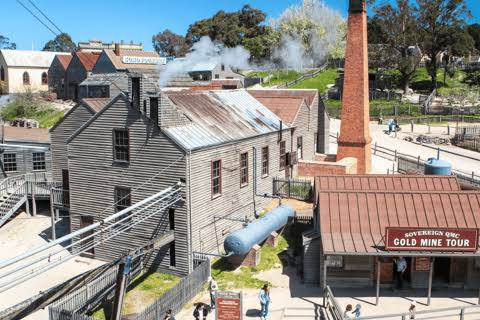
The historic Gold Mine Tour entrance and steam-powered machinery